Phive Dynamics  /  Toronto

Decision-grade organizational intelligence.
From the outside. Before the financials catch up.

You are entering a high-stakes window. Phive delivers outside-in intelligence tied to the financial KPIs the decision actually moves, built for moments when a leadership team cannot wait 12 weeks to learn whether the story is true.

Five business days· Day 1 the outcome · Day 3 the x-ray · Day 5 conviction
Regan Inkster presenting organizational coherence data to executives in a boardroom
The Two-Quarter Warning
Global Luxury Retailer · 8 quarters · Φ leads margin by ~2Q
Organizational ΦOperating margin %
Φ DROPSMARGIN FOLLOWS · ~2Q LATERQ2 23Q3 23Q4 23Q1 24Q2 24Q3 24Q4 24Q1 25Q2 25Q3 250.400.500.600.70Φ18%20%22%24%Margin %
What this shows: Φ began declining in Q3 2024 as seven concurrent transformation streams launched simultaneously. The financial dashboard showed nothing wrong. Two quarters later, operating margin compressed by 380 bps. The board learned what the outside-in signal had been reporting since Q3.
In a recent outside-in analysis, Phive identified that a “successful” CRM migration had actually destroyed 47% of customer relationship sentiment.See the full read →
Four destinations · One arc

The same engine, packaged for the four decisions where the cost of being wrong is highest.

Each engagement applies first-principles analysis to your industry, your company, and the specific area of focus to surface where value is being lost. Coherence measurement, tied directly to the financial KPIs the decision moves, explains why.

01 · CEO Transition · First 90 Days

CEO Transition Intelligence

Every new CEO inherits a narrative. Some of it is true. Some of it is incomplete. Phive pressure-tests it from the outside before it hardens.

  • Segment-by-segment coherence map across five employee bands
  • Hidden misalignment zones and where they are leaking value
  • The financial KPIs you will be measured on, traced to specific coherence breakdowns
  • 90-day intervention plan with sequencing and priority impact
Get the first-90 baseline →
Day 1: Intelligence Baseline · Day 3: Structural X-Ray · Day 5: Execution Conviction
02 · Diligence

Pre-Close Coherence Diligence

Your model assumes a value realization curve. Phive pressure-tests whether the organization can actually carry that curve — from the outside, before close.

In a recent outside-in analysis, Phive identified that a 'successful' CRM migration had actually destroyed 47% of customer relationship sentiment. Internal dashboards never tested for it.

  • Outside-in Phi score with three-year coherence trajectory
  • Stakeholder X-ray: customers, employees, suppliers, channels
  • Financial fingerprint linking Phi to the target's expected value realization
  • 10,000 Monte Carlo simulations on value-driving variables and sensitivity
  • Integration risk flags and Innovation Load Ratio scored against benchmarks
Day 1: Intelligence Baseline · Day 3: Structural X-Ray · Day 5: Execution Conviction
03 · Transformation

Transformation Readiness

Before committing the budget, Phive shows whether the organization has the capacity to absorb the change. The failure mode is organizational incapacity, not bad strategy.

Transformation metrics often measure adoption, not absorption. One company's migration hit every KPI target while customer trust collapsed beneath the surface.

  • Phi current state plus Change Capacity Score
  • Innovation Load Ratio: ambition versus absorption capacity
  • Value at risk modeled across 10,000 Monte Carlo simulations
  • Go / no-go recommendation with load-bearing coherence risks identified
Day 1: Intelligence Baseline · Day 3: Structural X-Ray · Day 5: Execution Conviction
04 · AI Strategy · The Decision Room

The board walks in on Day 1. They walk out on Day 5 with the execution architecture designed.

Most AI strategies are reports. This is a decision room — three Monte Carlo-tested options, a formula-traced workbook, 14 move cards with named owners, and the governance model that lands it.

What the board leaves with
Terminal Deck

~40-slide board walk-through. The narrative spine from diagnosis to decisions.

Three Options

Each tension-tested, each with capex, probability bands, and consequences. No hybrid traps.

Formula Workbook

11+ tabs, 277+ formulas. Change one assumption — watch the plan recalculate.

14 Move Cards

Each readable in 60 seconds. Purpose, owner, sequence, risk, buy / partner / build.

CLO Charter

The governance operating model. Not a recommendation — a standing body.

Competitive Map

10-dimension AI capability gap vs. peers + AI-native disruptor cohorts.

Five business days· Day 1 Intelligence Baseline → Day 3 Structural X-Ray → Day 5 Decision Room delivery
Day 1: Intelligence Baseline · Day 3: Structural X-Ray · Day 5: Execution Conviction
Field Notes · Anonymized structural teardowns

What hidden friction looks like at scale.

Three teardowns from the Phive portfolio. Each one shows a pattern the financials will surface two quarters later. Each one was visible from the outside, on Day 1.

Brief A · Turnaround Illusion

Executives see strength. Customers see decay.

Anonymized · Global QSR brand · 4 quarters pre-CEO transition
Brand authenticityService qualityInnovationPrice-value0.00.51.0
Executive perceptionCustomer reality

Executive perception vs. customer reality. Across four brand pillars, the executive narrative said the company was strong. Outside-in signal said customers had already moved on. The gap widened for four quarters before the board acted. The CEO replacement followed the signal, not the other way around.

Brief B · Absorption Trap

Five acquisitions in 18 months. ILR hit 2.78.

Anonymized · Private credit platform · post-acquisition spree
2.78
ILR · Critical

Innovation Load Ratio breached the 2.5 critical threshold. When ambition outruns absorption capacity, integration costs eat the synergy thesis. Across the Phive portfolio, transformations launched at ILR above 2.5 fail to land 78% of the time. The acquirer kept buying. The math kept getting worse.

Brief C · Integration Failure

The deal thesis was sound. The transmission couldn't carry it.

Anonymized · Mid-cap tech merger · 2 quarters post-close
Board & C-SuiteVP / DirectorManager / ICFrontline0.00.30.50.81.0

Coherence by organizational layer, two quarters post-close. The board and C-suite report a successful integration. Two layers down, the story inverts. Frontline coherence has collapsed, customers feel it, and the synergy curve in the model is now a fiction. Visible outside-in. Invisible in the dashboard.

Sample Read · The Migration That Looked Like a Win

See what a full outside-in read looks like.

A sample X-Ray showing what internal dashboards miss — including a CRM migration that looked like a success until you listened to 200,000 customer posts.

Read the sample →
Insights · Three Tech Companies. One Pattern.

41 quarters of coherence data across a cloud platform, a semiconductor roll-up, and an enterprise software firm.

Layoffs crater it. Acquisitions fragment it. The signal often diverges from the narrative first.

Read the tech sector analysis →
The engine · Why this works

Coherence is not sentiment. It is a measurable operating signal.

Organizational Φ correlates with 52 of 76 financial metrics tested across 40+ quarters, leading by 2–4 quarters. The signal is readable 4–6 quarters before it shows up in earnings.

Phi correlates with the metrics that matter
18 representative financial metrics · sorted by absolute Pearson r
ProfitabilityEfficiencyGrowthLeverage
Debt to Equity-0.83Equity Ratio+0.78Gross Profit+0.70Asset Turnover+0.69Operating Income+0.67Free Cash Flow+0.67Revenue per Employee+0.66Revenue+0.64Operating Income / Employee+0.64Days Sales Outstanding-0.59SGA to Revenue-0.55Operating Margin+0.55Cash Conversion Cycle-0.54Total Debt to Assets-0.52EBITDA YoY % (4Q lag)+0.45Operating Income YoY % (4Q lag)+0.45Net Margin+0.44Revenue YoY % (4Q lag)+0.40-1-0.50+0.5+1
The read: Coherence is measurable. It predicts financial outcomes. The signal is readable 4–6 quarters before it shows up in earnings. Internal dashboards measure what already happened. Phive measures what is about to.
How the engine works

Phi (Φ) measures the alignment between what a company says, what it means, and what it does. The math draws from integrated information theory in neuroscience and applies it to enterprise: the more aligned the parts, the more coherent the whole. The more coherent the whole, the more value it produces, and the longer it takes for that value to leak.

α

Shared Reality

Do people across levels and functions see the same facts, or has the organization fragmented into silos where sales believes one story, engineering another, and finance a third?

β

Shared Meaning

When strategy cascades through layers, does it stay intact, or does each function turn it into something the original is no longer recognizable in?

γ

Shared Intent

Given the same situation, will different parts of the organization make compatible decisions, or will they optimize for conflicting outcomes?

Organizational psychology
Financial & KPI benchmarking
Psycholinguistics
Industry & peer pattern libraries
Behavioral science
Movement & mobility analytics
Organization theory & management science
AI-native operating model research

The agent stack applies hundreds of validated frameworks to over 1.5 billion data points spanning more than ten years of organizational, financial, and behavioral signal. Each framework contributes one dimension. The synthesis is what compresses a $1M, twelve-week engagement into a five-day sprint.

The correlation chart shows that Φ predicts financial outcomes. The X-Ray shows where the signal is breaking down — and why internal dashboards miss it. See a sample X-Ray →
The deliverable

See what a full outside-in read looks like.

An anonymized sample of the intelligence Phive produces in five business days. Coherence baseline, divergence analysis, change-capacity scoring — the working layer your team owns going forward, not a slide deck.

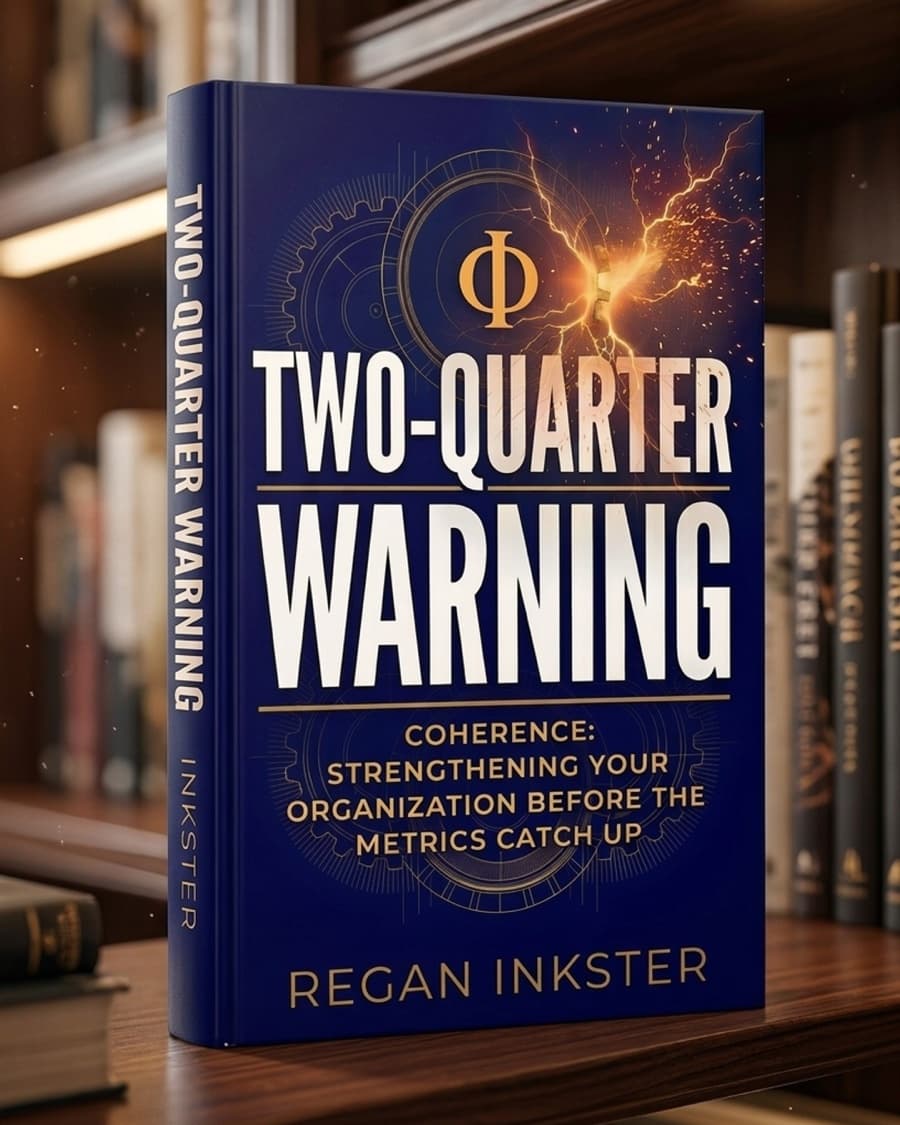
Two-Quarter Warning by Regan Inkster — book cover on a wooden surface in front of a library shelf
The foundational theory

The book behind the methodology.

Organizations do not fail suddenly. They fragment quietly, long before the numbers show it. Two-Quarter Warning introduces Organizational Phi (Φ) as a measurable leading indicator that tracks how faithfully strategic intent transmits from boardroom to frontline. When coherence drops, financial performance follows roughly two quarters later. Every time.

The instruments leaders currently rely on (engagement scores, OKRs, town halls) cannot detect this. They measure sentiment and activity, not transmission fidelity. By the time the quarterly numbers report the danger, the fragmentation happened six months ago.

The book is the methodology in long form: how to read coherence, how to strengthen it, and how to act on the signal before the metrics catch up. It is the instrument leaders have been missing.

Read the methodology on Substack. Get notified when the book ships.

If you are in or about to enter a decision moment, tell us which one.

We respond within one business day with a scoped proposal or a short conversation, whichever fits the decision window.